

Monaco’s property market is often reduced to a single price per square metre. Yet anyone reviewing monaco real estate for sale will encounter a much more segmented picture. District, building generation, condition, outlook and scarcity within a particular category can matter as much as the headline average. The latest official figures are therefore most useful as context, not as a substitute for an analysis specific to your search.
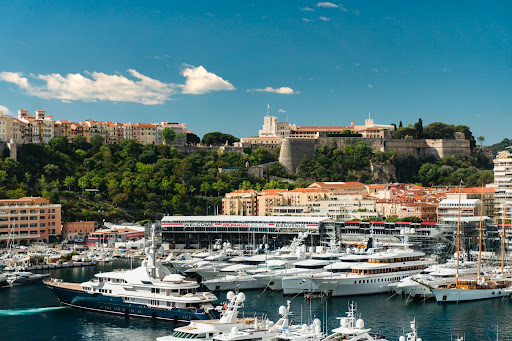
Alt text: Yachts in Port Hercule, Monaco, with Le Rocher and La Condamine in the background
Monaco Real Estate for Sale: What the Official Figures Represent
The latest IMSEE Real Estate Observatory records 493 residential transactions, 5.8% more than in the preceding period. Their combined value remained close to the previous record at €5.9 billion. Beneath those totals, however, new-build sales and resales moved in opposite directions.
There were 64 new-build sales, down from the exceptional level seen in 2024, while resales rose 17.5% to 429 transactions. The value of resales increased by 49.1% to a record €3.25 billion. This does not mean every apartment appreciated at the same rate. Recently completed, high-specification residences entering the resale market, such as prime units in Mareterra, had a considerable effect on the average ticket size and reported price levels.
For a buyer examiIMSEE’s latest methodology estimates the overall price at €57,569 per square metre. The same report places Larvotto at €71,167 per square metre, compared with €54,009 in Monte-Carlo, €52,518 in Fontvieille and €43,797 in Moneghetti. These are modelled district estimates, not valuation grids for individual apartments.
Even within one address, values change with floor level, orientation, natural light, view protection, terrace depth, parking, renovation standard and the efficiency of the layout. Two properties with the same stated surface may offer very different usable living experiences. This is why searches for real estate in Monaco should move quickly from broad averages to comparable evidence at building and apartment level.ning monaco real estate for sale, the distinction is significant. A market-wide movement may reflect which homes changed hands rather than a uniform repricing across districts and time.
What Monaco Real Estate Buyers Should Consider When Comparing Properties
The age of a building also provides only part of the answer. IMSEE estimates properties completed since 2020 at €65,602 per square metre on average, but a well-positioned older residence may still command a premium when it offers proportions, views or an address that cannot easily be replicated.
Real Estate in Monaco: Choosing the Right Type of Ownership
The right purchase depends first on its intended role. A main residence may place greater weight on bedroom count, storage, school routes and day-to-day convenience. A pied-à-terre may prioritise concierge services and a central position. An investment purchase introduces another set of questions, including likely tenant demand, service charges, maintenance and the depth of the future resale market.
The transaction figures also show why budget alone is not a complete search brief. Studios and two-room apartments represented more than half of resale volumes, while larger homes accounted for a disproportionate share of value. Each segment has its own buyer pool and supply constraints.
Approaching real estate in monaco with a defined use case makes comparisons more disciplined. It also helps a broker distinguish between a property that is simply attractive and one that is genuinely suitable, correctly positioned and defensible over time.
A Market Where Context Creates Clarity
Monaco remains unusually limited in physical supply, but scarcity does not remove the need for selectivity. The most reliable decisions combine official market data with recent comparable transactions, knowledge of individual buildings and a clear view of the buyer’s priorities.
The official figures confirm a highly active and valuable market. The more important lesson is that averages are shaped by composition. Buyers who understand what sits behind the numbers are better placed to judge price, recognise quality and act with conviction when the right property becomes available.
The Due-Diligence Questions Behind the Price
Before a buyer decides whether an asking price is justified, the apartment and the building should be examined separately. At property level, the plan, title documentation, condition and included ancillary spaces need to match the presentation. At building level, recent meeting records, planned capital works, service arrangements and the pattern of charges provide a fuller view of ownership.
Renovation requires the same discipline. The relevant number is not simply a contractor’s initial estimate, but the likely all-in cost, the time required and possible practical constraints. Permissions, access, delivery hours and building rules can influence both programme and budget. A lower purchase price may cease to be attractive if the work needed to reach the desired standard is underestimated.
For financed acquisitions, preparation also affects negotiating strength. A buyer who has discussed the structure, established proof of funds and identified the advisers required can evaluate an opportunity faster without reducing scrutiny. In a constrained market, speed is most useful when it is the result of work completed in advance rather than pressure applied after a viewing.
From Asking Price to Defensible Value
Asking prices reveal how owners wish to position their properties; completed transactions reveal where buyers and sellers have actually agreed. A sound opinion of value considers both, then adjusts for the features that make the subject property better or worse than the evidence available. When no recent transaction is truly comparable, the range of reasonable values may need to remain wider.
This is where experienced advice adds practical value. The objective is not to force every apartment into a formula, but to explain which part of the price is supported by the market and which part reflects exceptional scarcity, superior quality or seller expectations. That distinction gives buyers a clearer basis for an offer and helps them understand when waiting is prudent and when replacement opportunities may be genuinely limited.
Data source: IMSEE Observatoire de l’immobilier 2025.
